
What a Morse Code Radiogram Is
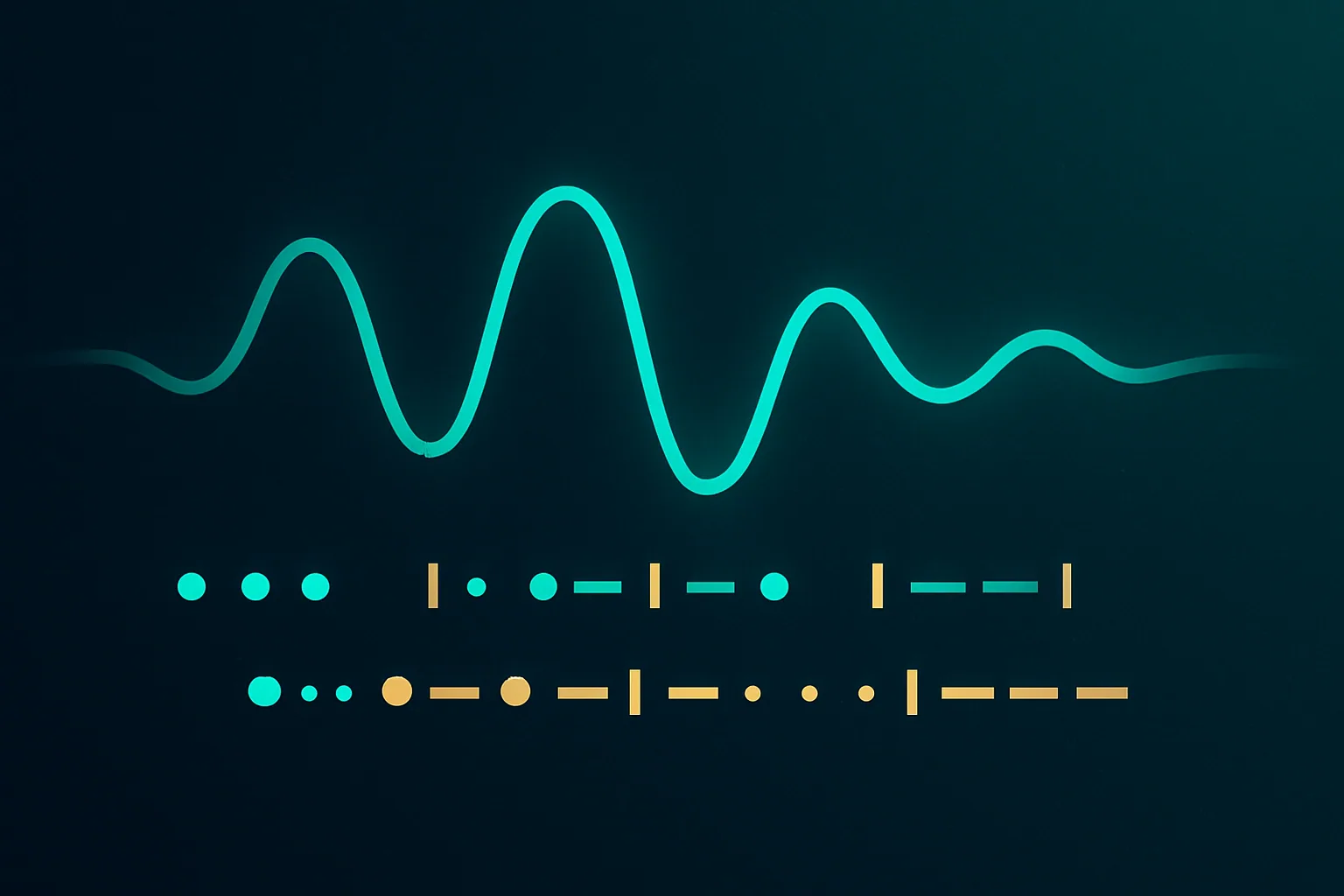
A radiogram is a message transmitted with Morse code over sound or radio. The operator keys letters as short and long pulses, and the receiver writes the dots and dashes down before reading them back as text.
Because the signal is a continuous stream, the only thing separating one letter from the next is timing: a short gap inside a letter, a longer gap between letters, and a longer gap still between words.
Why the Split into Letters Matters
Morse code is not a prefix-free code: one letter’s pattern can be the start of another. The signal "...." is the letter H, but the same four dots could also be read as S then E, or as five other combinations, if the gaps are lost.
This is the heart of the classic textbook task: when the split into letters is unknown, you must restore it using the pauses and the known alphabet. Get the spacing right and the message is unique; lose it and the same dots and dashes decode many ways.
Alphabet sample
.-B -...C -.-.D -..E .F ..-.G --.H ....I ..J .---K -.-L .-.. Decode the Radiogram Step by Step
First mark the gaps: separate the stream into letter groups by the longer pauses, then group letters into words by the longest pauses. Write a space between letters and a slash between words.
Then map each group to a character using the Morse alphabet, and paste the spaced sequence into the decoder below to check your answer instantly.
Check Your Answer with the Decoder
Type or paste the dots and dashes, keeping one space between letters and a slash between words, and the decoder returns the text. If a group shows as unknown, the spacing is off — usually a missing or extra gap.
The iOS and Android app goes further: it plays a radiogram as audio at a set speed and can decode Morse it hears through the microphone, so you can practice receiving by ear, fully offline.
Try the Morse translator
You've received a message in Morse code
Play it, reveal the text, or decode it yourself in the translator below. You can also write your own message there, turn it into Morse, and share it the same way — or get our free app to send SOS signals, decode audio, and learn Morse code.
This message was composed by the sender. We do not store shared messages and are not responsible for their content.
Some characters are not supported by this alphabet.
Related guides
Frequently Asked Questions
Can Morse code be used without internet?
Yes. Morse code is a signal system, so encoding, decoding, and audio playback can work fully offline.
Does every language use the same Morse alphabet?
No. English uses International Morse, while Russian, Arabic, Japanese Wabun, Hebrew, Greek, and Korean SKATS have their own mappings.
How do I decode a radiogram when the split into letters is unknown?
Restore the letter boundaries from the pauses first: a longer gap ends a letter, the longest gap ends a word. Then map each dot-dash group to a character. With the spacing rebuilt, the decoding is unique.
Why can the same Morse signal mean different letters?
Morse is not prefix-free, so without gaps one letter’s pattern can begin another. The pauses between signals are what make the split into letters, and the message, unambiguous.
Can I check the answer to a Morse radiogram task?
Yes. Paste the dots and dashes into the decoder with a space between letters and a slash between words, and it returns the text instantly.