
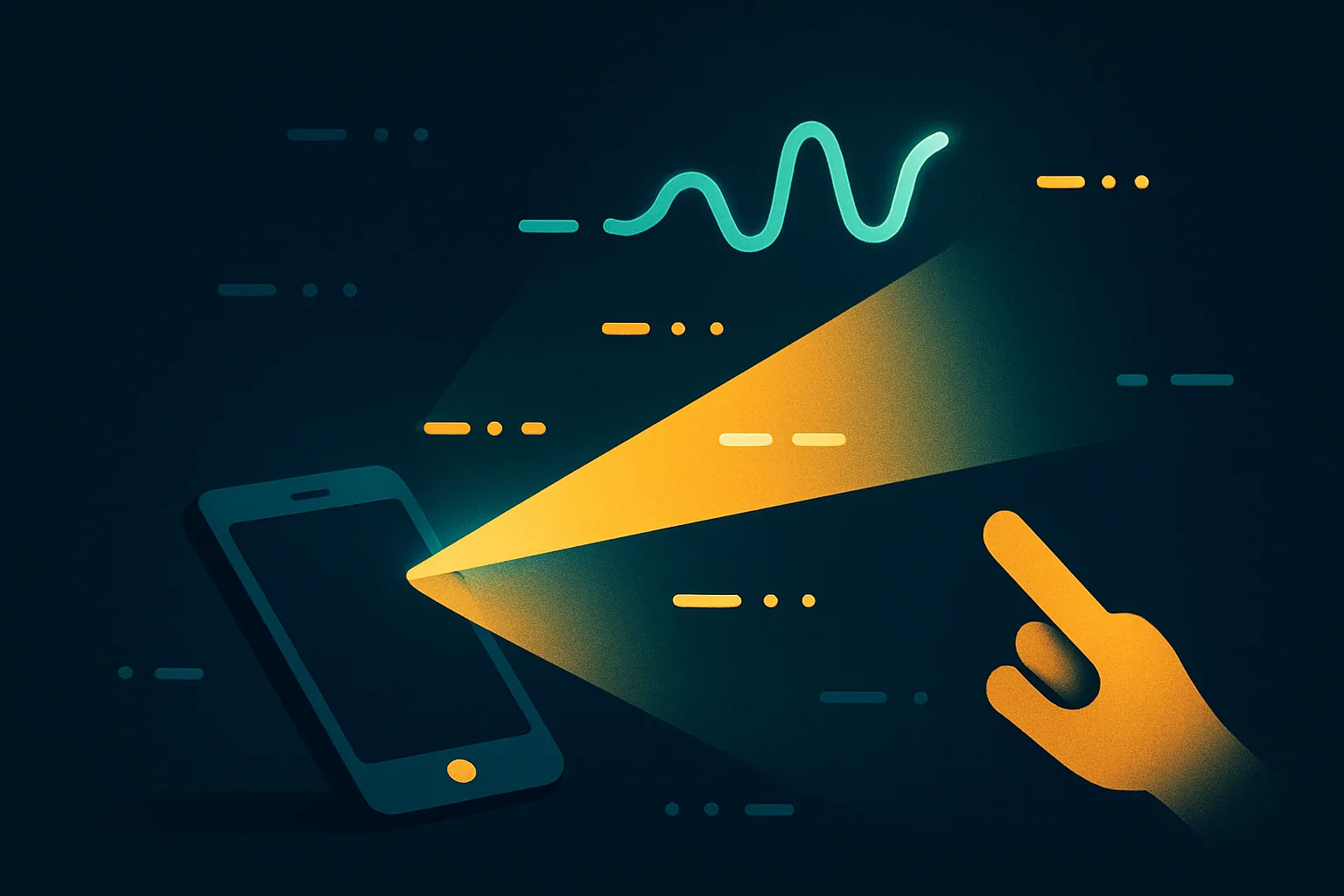
Three Ways to Send Morse Code
Encode your text first, then transmit the dots and dashes through any channel: an audible tone, a flashing light, or a tapped pulse. The timing is identical — short for a dot, three times longer for a dash, with set gaps between letters and words.
Sound carries fastest and is easiest to read by ear; light reaches across a room or a dark distance; tapping works silently, hand to hand or on a hard surface.
Send Morse with Sound
A clean tone makes Morse easy to recognise because the rhythm becomes an audible shape. The app plays your message as audio at a speed you choose, so you can practice listening or signal out loud.
Speed is measured in words per minute. Start slow to keep the dot-dash spacing clear, then raise the pace as your ear adapts.
Alphabet sample
.-B -...C -.-.D -..E .F ..-.G --.H ....I ..J .---K -.-L .-.. Send Morse with a Flashlight
Light signaling uses the same timing as sound: a short flash for a dot, a long flash for a dash. It is the classic way to reach someone across a distance or in the dark.
The app can flash the message on the phone’s flashlight, and combine sound and light together at the same time — that combined mode is free to try a few times before a one-time unlock.
Decode Morse by Sound
Receiving is the other half of signaling. The app’s audio decoder listens through the microphone and turns knocks, claps, taps, or a Morse tone back into text — processed locally on the device, with nothing recorded or uploaded.
That means you can capture a signal someone taps near the phone, or check your own keying by ear, fully offline.
Try the Morse translator
You've received a message in Morse code
Play it, reveal the text, or decode it yourself in the translator below. You can also write your own message there, turn it into Morse, and share it the same way — or get our free app to send SOS signals, decode audio, and learn Morse code.
This message was composed by the sender. We do not store shared messages and are not responsible for their content.
Some characters are not supported by this alphabet.
Related guides
Frequently Asked Questions
Can Morse code be used without internet?
Yes. Morse code is a signal system, so encoding, decoding, and audio playback can work fully offline.
Does every language use the same Morse alphabet?
No. English uses International Morse, while Russian, Arabic, Japanese Wabun, Hebrew, Greek, and Korean SKATS have their own mappings.
How do I send a message in Morse code?
Encode the text to dots and dashes, then transmit it as sound, light, or taps using the same timing — short for a dot, longer for a dash, with gaps between letters and words. The app can play it as audio or flash it on the flashlight.
Can the app decode Morse code from sound?
Yes. The audio decoder listens through the microphone and converts knocks, claps, taps, or a Morse tone into text locally on the device, with no recording or internet connection.
Is flashlight signaling free?
Sound-only and flashlight-only signaling are free. Combining sound and flashlight together is free to try a few times, then a one-time in-app purchase.